
Music frozen into light
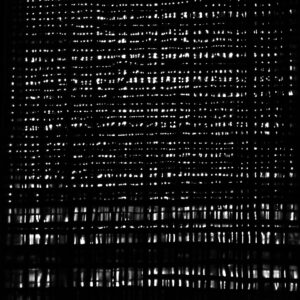
Architecture is often described as “frozen music” – a metaphor that speaks to the shared rhythm and structural complexity of buildings and musical compositions. This photographic series captures the lights of the city at night in an abstracted form, removing the architectural framework to reveal the pure visual rhythm of urban life. The vibrant, pulsating energy of the city transforms into a swirling composition of light – like a musical score rendered in luminous gestures. What we see is not the city itself, but the echo of its movement and intensity: music frozen into light.
Music frozen into light reprompted
This series emerges from a dialogue between human imagination and algorithmic processes. Trained on the original photographs of the Music frozen into light series (also exhibited here), an AI model reformulates the visual impressions of the city’s nocturnal rhythms. What began as a photographic abstraction of urban light is now reinterpreted with the assistance of the algorithm, generating images that echo – and at times distort – the pulse and structure of the source material. The results are recursive compositions in which the city’s energy is not only frozen into light but reimagined through the logic of the algorithm. These images are no longer indexical photographs, but quasi-indexical echoes of photographs: a score, endlessly remixable, suspended between memory and invention.
….
Zsolt Bátori is a philosopher of art, a photography theorist, a practicing fine art photographer, and a curator. His work bridges theory, image-making, and contemporary debates on AI-generated visual culture.
After earning his PhD in Philosophy from Rutgers University, he has taught and conducted research at universities in Hungary, the USA, Spain, and Argentina. His primary area of research is the philosophy of art and aesthetics, with a particular focus on the philosophy and theory of the visual arts and photography. He is especially interested in questions concerning engagement with artworks, photographic meaning construction and interpretation, and how generative AI reframes questions of authorship, creativity, deception, trust, and responsibility. As a photographer, he has exhibited his work internationally, focusing on projects about visual memories, landscape and social change, and abstracting ordinary scenes – through both photographic means and generative AI – into distinctively novel perceptual and cognitive experiences.
Zsolt is a researcher at the Faculty of Music and Visual Arts at the University of Pécs, and a member of philosophy and aesthetics research groups at the University of Murcia and Pompeu Fabra University in Barcelona. He also teaches at EINA, School of Art and Design (Autonomous University of Barcelona) as an adjunct instructor. His teaching connects conceptual rigor with practice-led inquiry into photographic and computational image-making.
Continue reading on the website
May 26–June 10, 2026
Opening reception:
Tuesday, May 26, 2026, at 6:30 p.m.
Free admission
Monday–Friday: 10:13 a.m.–4:19 p.m.
In collaboration with
Centro Sperimentale di Fotografia Adams
Via Biagio Pallai 12
Roma
kromartgallery@gmail.com or info@csfadams.it
Monday–Friday: 10:13 a.m.–16:19 p.m.